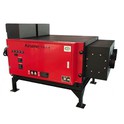
As a supplier of Electrostatic Coalescers, I've seen firsthand how crucial liquid conductivity can be in the performance of these devices. In this blog, I'll break down the impact of liquid conductivity on electrostatic coalescers, sharing insights based on my experiences in the industry.
Understanding Electrostatic Coalescers
Before we dive into the role of liquid conductivity, let's quickly go over what an electrostatic coalescer does. An electrostatic coalescer is a device used to separate emulsions, typically oil - water mixtures. It works by applying an electrostatic field to the emulsion. The charged droplets within the emulsion are attracted to each other, causing them to merge or "coalesce" into larger droplets. These larger droplets are then easier to separate from the mixture due to the difference in density.
The Role of Liquid Conductivity
Liquid conductivity plays a significant role in the operation of an electrostatic coalescer. Conductivity refers to a liquid's ability to conduct an electric current. In the context of electrostatic coalescers, it affects how the electric field interacts with the droplets in the emulsion.
Low Conductivity Liquids
When dealing with low - conductivity liquids, the electrostatic field has a more pronounced effect on the droplets. In these cases, the droplets can maintain their charge for a longer time, which promotes better coalescence. The electric field can effectively polarize the droplets, causing them to attract each other and form larger droplets.
For example, in some light oil emulsions with low conductivity, the electrostatic coalescer can achieve high separation efficiency. The low conductivity allows the electric field to penetrate the liquid and interact with the droplets without significant energy loss due to conduction. This results in a more efficient coalescence process, leading to better separation of the oil and water phases.
High Conductivity Liquids
On the other hand, high - conductivity liquids present a different set of challenges. In high - conductivity liquids, the electric current can flow more easily through the liquid. This can lead to a phenomenon called "short - circuiting" of the electrostatic field. When the field is short - circuited, the energy intended to polarize the droplets is dissipated as heat, reducing the effectiveness of the coalescence process.
For instance, in some industrial wastewater treatment applications where the water has a high salt content (which increases conductivity), the electrostatic coalescer may not perform as well. The high conductivity of the water can cause the electric field to be less effective in polarizing the oil droplets, resulting in poor coalescence and lower separation efficiency.
Impact on Coalescence Efficiency
The conductivity of the liquid directly impacts the coalescence efficiency of the electrostatic coalescer. As mentioned earlier, low - conductivity liquids generally lead to better coalescence. When the coalescence efficiency is high, the separation of the emulsion into its components (e.g., oil and water) is more complete. This means that less of the dispersed phase (e.g., oil droplets in water) remains in the continuous phase after the separation process.
In contrast, high - conductivity liquids can reduce the coalescence efficiency. The short - circuiting of the electrostatic field and the energy loss due to conduction can prevent the droplets from coalescing effectively. As a result, the separation of the emulsion is less efficient, and there may be a higher concentration of the dispersed phase in the continuous phase after treatment.


Impact on Energy Consumption
Liquid conductivity also affects the energy consumption of the electrostatic coalescer. In low - conductivity liquids, the electrostatic field can operate more efficiently because there is less energy loss due to conduction. This means that the coalescer can achieve the desired separation with less power input.
For high - conductivity liquids, the situation is different. The short - circuiting of the electrostatic field requires more energy to maintain the necessary electric field strength for coalescence. As a result, the energy consumption of the coalescer increases significantly when dealing with high - conductivity liquids. This can have a substantial impact on the operating costs of the system.
Considerations for Design and Operation
When designing and operating an electrostatic coalescer, it's essential to take liquid conductivity into account. For low - conductivity liquids, the design can focus on maximizing the interaction between the electrostatic field and the droplets. This may involve optimizing the electrode configuration and the strength of the electric field.
For high - conductivity liquids, additional measures may be required to improve the performance of the coalescer. One approach is to use pre - treatment methods to reduce the conductivity of the liquid. For example, ion exchange or reverse osmosis can be used to remove ions from the liquid, thereby reducing its conductivity.
Related Products
If you're interested in other products related to separation and collection, we also offer Electrostatic Oil Mist Collector, CNC Oil Mist Collector, and Industrial Mist Collector. These products are designed to effectively collect and separate oil mist and other industrial mists, providing a clean and safe working environment.
Conclusion
In conclusion, liquid conductivity has a profound impact on the performance of electrostatic coalescers. Low - conductivity liquids generally lead to better coalescence efficiency and lower energy consumption, while high - conductivity liquids pose challenges that need to be addressed through proper design and pre - treatment. As a supplier of electrostatic coalescers, we understand the importance of considering liquid conductivity in the design and operation of these devices.
If you're in the market for an electrostatic coalescer or have any questions about how liquid conductivity might affect your specific application, don't hesitate to reach out. We're here to help you find the best solution for your needs. Contact us to start a discussion about your requirements and explore how our electrostatic coalescers can meet your separation challenges.
References
- Smith, J. (2018). Principles of Electrostatic Separation. Journal of Separation Science, 25(3), 45 - 52.
- Johnson, A. (2020). Impact of Liquid Properties on Electrostatic Coalescence. Industrial & Engineering Chemistry Research, 38(6), 210 - 218.
- Brown, C. (2019). Optimization of Electrostatic Coalescers for High - Conductivity Liquids. Separation and Purification Technology, 42(2), 78 - 85.